Picture T&A
POLISH ANNA
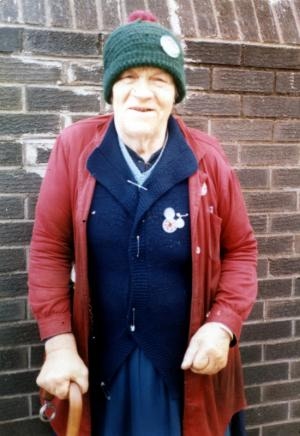
She became known as "Big Anna", "Russian Anna", "Polish Anna" and was one of Bradford's more colourful characters.
If you were around the City from the 60s to the 80s you would have known about her.
Anna would hang around John Street Market, helping the traders in exchange for cups of tea. She was large, strong and wore lots of badges in the lapels of her jacket. She always carried a big, square, hessian bag full of money. She wore an old hat, an Army great coat and big boots. She would whistle away, fingers in her mouth.
She would sometimes sing in a thunderous voice that set the pigeons rising from the market roof or she would bang her walking stick down on dustbin lids, causing unsuspecting passers-by to leap for safety.
People would make fun of her and keep a wide berth from her.
She used her big frame to bully the traders and would demand food and drinks which they gave to her for an easy life.
She also had a very soft loving side and would protect people in trouble. She loved children and she did get upset when they were cruel to her and ran away.
Now lots of Bradfordians have fond memories of her and would like to know her story.
HOW SHE BECAME "POLISH ANNA!"
Many people knew Anna by sight and reputation but it seemed that no-one quite knew her actual story, how she came to Bradford, where she had come from or what had happened to her. There had been rumours for years that she had been experimented on by the Nazis in a concentration camp.
Her behaviour wasn't caused by an illness. It was because of the horrors she had seen and gone through in the camp as a young woman.
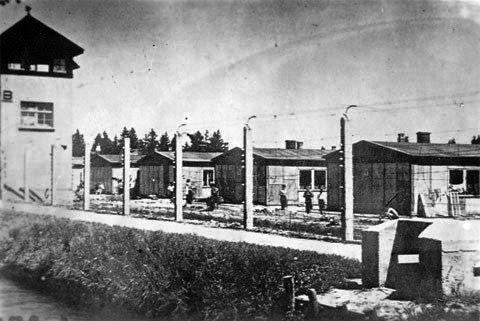
One can only imagine the horrors she witnessed and was put through. Only now that she has gone do so many people have good memories of Polish Anna. Her life is somewhat a mystery and a matter for speculation.
It is believed she was a victim of Dachau Concentration Camp and rumour had it that she had been experimented on during her time there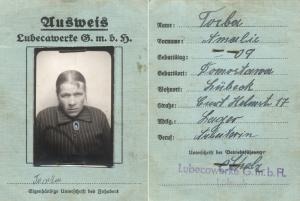
Anna's ID Card (T&A)
The ID Card is an "Ausweis" (foreign worker) identity work permit that was issued by a factory in Lubeck in Northern Germany. It actually shows she was a foreign slave labourer in what we believe was a tin can factory. Conditions for workers would have been terrible but it shows she wasn't in a concentration camp at this time in her life.
She once told someone that she had trained as a doctor, "...but the fascists had put an end to that?" Could she really have once been an academic?
Her real name was Aniela Torba born in around 1909.
They were said to have injected her with steroids, testosterone and god knows what else and people even told stories of them trying to transform her into a man but there was no evidence to say she wasn't a woman.
She had some damage to her head and always wore a hat to cover it. She had a number tattooed on her wrist from the concentration camp. The way she hoarded money was a reflection on prison camp behaviour. When the war ended she found herself being ill-treated again but this time by the Russians. She escaped from one tyranny to another.
Nobody knows how she made it to England!
The earliest picture we can find is when Anna was at Morton Banks Fever Hospital from 1950-1952. She helped out around the place often.
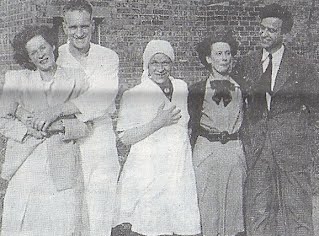
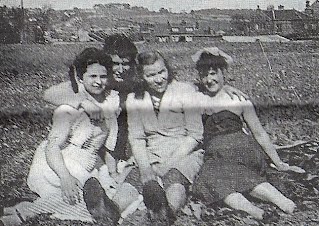
Early pictures of Anna (courtesy of T&A)
A man who lived near her home in Chain Street picked up an envelope that had been thrown out near a skip. It contained a collection of photographs from Anna's life.
She loved the Royal family and always carried a picture of the Queen. One thing that terrified her were marching bands and she would run a mile on seeing or hearing one and she didn't like loud bangs either. One insensitive boy once sneaked up behind her with a toy pistol and put it to her head and she went mad and chased him all around the market.
She was taken in by a Polish family in the early 1970's in Farcliffe Road, Heaton living in the dormer. Because of her strength she would often get jobs in the local mills moving heavy bails about.
She had a friend in Halifax, a small lady, with the same sort of tattoo. Anna used to go into the toilets at John Street Market and talk to herself in the mirror. A friend in Halifax said the other lady used to do the same thing there.
Anna used to sleep on the benches in Little Horton Park during the day.
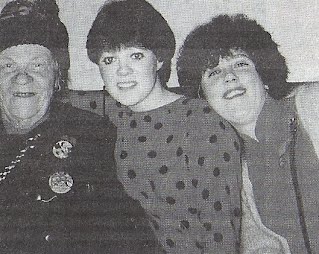
Anna with some friends in the Sun Pub 1980's
A former Bradford Market trader says he collected for a seat for Anna in John Street Market and used to give her breakfast.
He says, "One day she didn't turn up at the market." He went to her house in Chain Street but could get no reply from inside. The police eventually broke in and found her laid at the back of the door with a broken femur.
She was taken to hospital but sadly died later. As someone close to her, the trader was required to be present when the coroner's officer counted the money found in the house; £8,000 in half-crowns and two-shilling pieces.
Funeral directors, D Walsh & Sons did the funeral at St. Patrick's in Westgate. There were seemingly no relatives so they did the funeral because Anna used to attend St Patricks.
Anna was later buried in the Polish section of North Bierley cemetery. A relative did turn up at the funeral from Vienna, Austria but no one spoke to her. So it's left to these photographs to offer some clues to a young womans life in Poland and later a Bradford life as "Polish Anna!" What happened in between remains a mystery.
Aniela (Anna) Torba died on 5th December 1985 aged 76 years.

